Robotic palletizing
Inputs: box dimensions and mass, tooling, pallet pattern, height and target cycle. Test: grasping the full product range, reach in every position, cycle time and safe pallet handover.
Applications / feasibility
A humanoid pilot has value when the job, environment and success criteria are clear. We explore where human-scale mobility, manipulation or interaction may justify a trial.
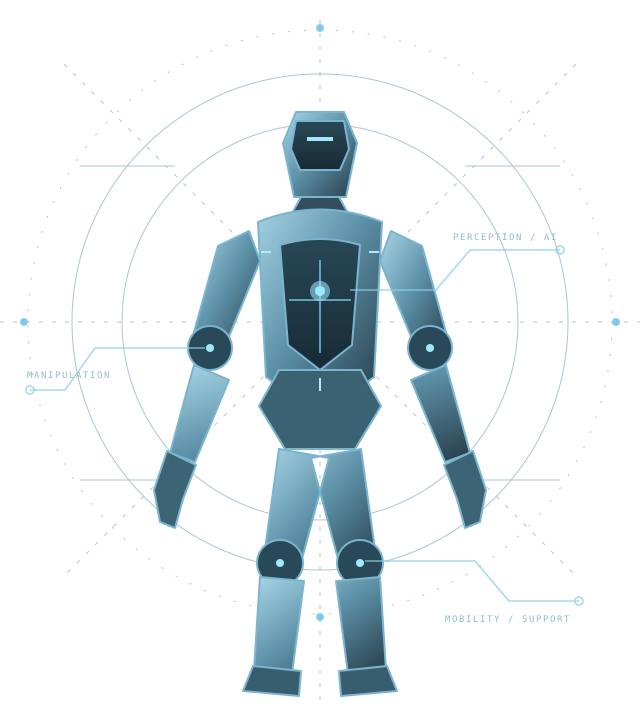 50°05' N / 14°25' EHUMAN · SYSTEM · ENVIRONMENT
01 / Applications
The following briefs help prepare a feasibility assessment. They are not customer installation references or guaranteed robot performance.
Inputs: box dimensions and mass, tooling, pallet pattern, height and target cycle. Test: grasping the full product range, reach in every position, cycle time and safe pallet handover.
Inputs: machine and interfaces, parts, fixtures, doors, clamping and coolants. Test: repeated part loading and unloading, fault recovery and machine-signal coordination.
Inputs: representative images including difficult cases, cameras, lighting and acceptable error. Test: detection or localization accuracy, latency, uncertainty handling and control integration.
02 / Applications
Teaching, experiments and reproducible studies on physical AI.
Perception, action planning, learning and human-in-the-loop development.
Bounded manipulation or inspection tasks in assessed industrial environments.
Structured movement and handling trials with clear operational constraints.
Guidance and interaction where accessibility and human escalation are designed in.
Supervised product demonstrations and visitor engagement.
Time-bounded demonstrations with staffing, safety and contingency plans.
Defined observation routes and data-handling requirements.
Remote control for research or supervised tasks within a defined operating envelope.
ImportantEvery application requires individual feasibility, safety, integration and operating-condition assessment.
03 / Applications
These are questions for a future feasibility discussion, not customer deployments or validated platform capabilities.
Task: move one defined item along a marked route. Check floor, doors, load and people nearby. Measure completed trips and interventions; keep a human handling path.
Task: answer a limited set of location questions. Check noise, accessibility, privacy and safe movement. Measure resolved requests and handovers; a staffed desk remains the fallback.
Task: capture specified observations at marked points. Check access, lighting, data rights and recording rules. Measure usable records and missed points; a trained person verifies exceptions.
04 / Applications
Define the task frequency, environment, people nearby, required manipulation, data flows, failure response and the value of the outcome. Compare a humanoid with simpler alternatives where appropriate.
05 / Applications
ImportantIf the task cannot be bounded or a simpler approach meets the same need, a humanoid pilot may be premature.