
What have we done?
MALONI Mini is now the priority of MALONI’s own development. Rostislav Sikora has decided to focus the next stage on a small AI companion with a planned soft textile cover. Humanoid 120 remains part of the project’s history; this is not an announcement of its permanent cancellation.
This update is based on CAD V2.1 documentation, revision dated 12 November 2026, supplied by the project lead. This entry is published on 13 November 2026. The documentation describes a design for shape and mechanical fit validation, not yet verified by physical assembly. It is neither a certified product nor a design approved for series production.
What is documented?
What is MALONI Mini intended to look like?
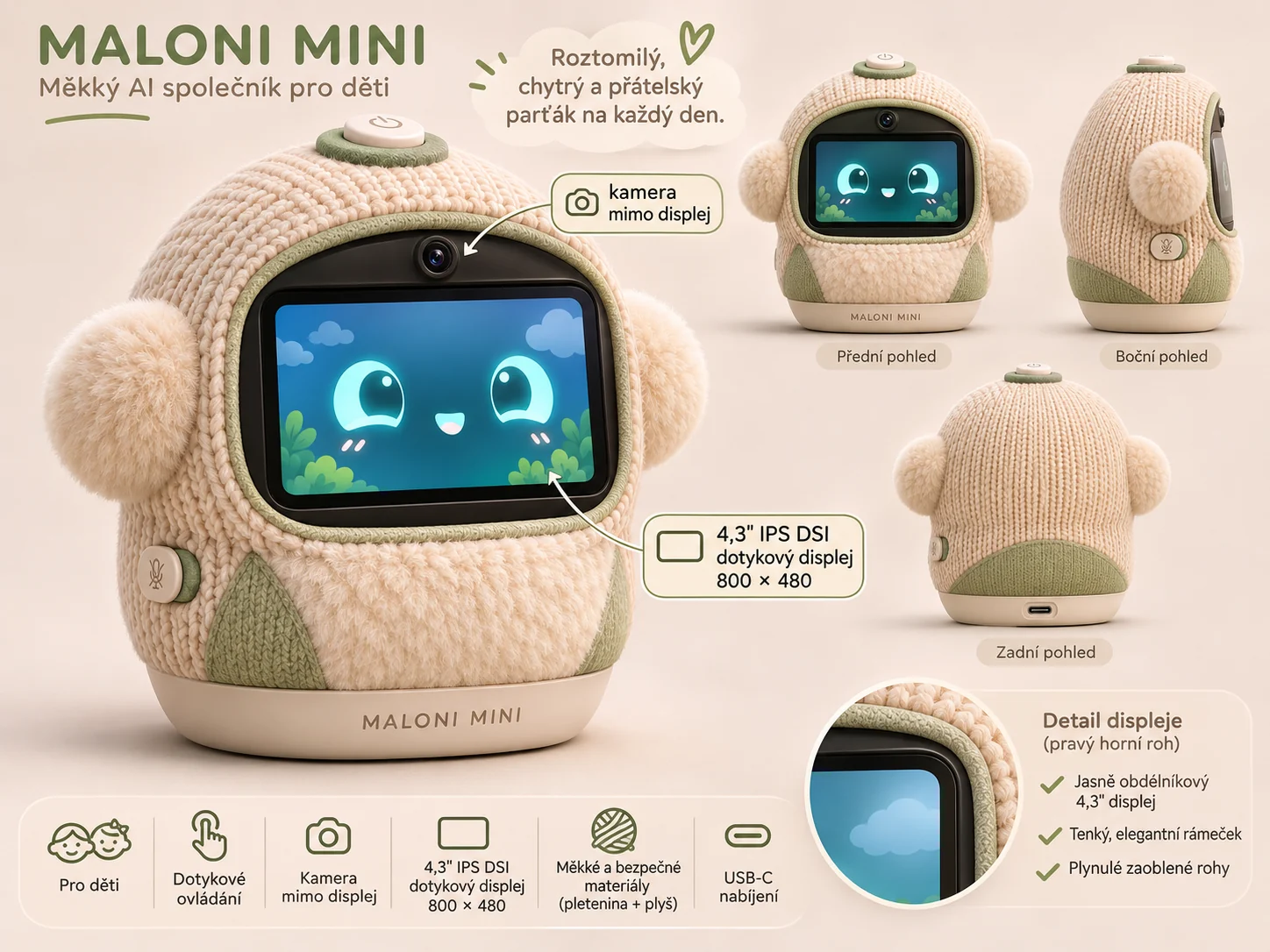
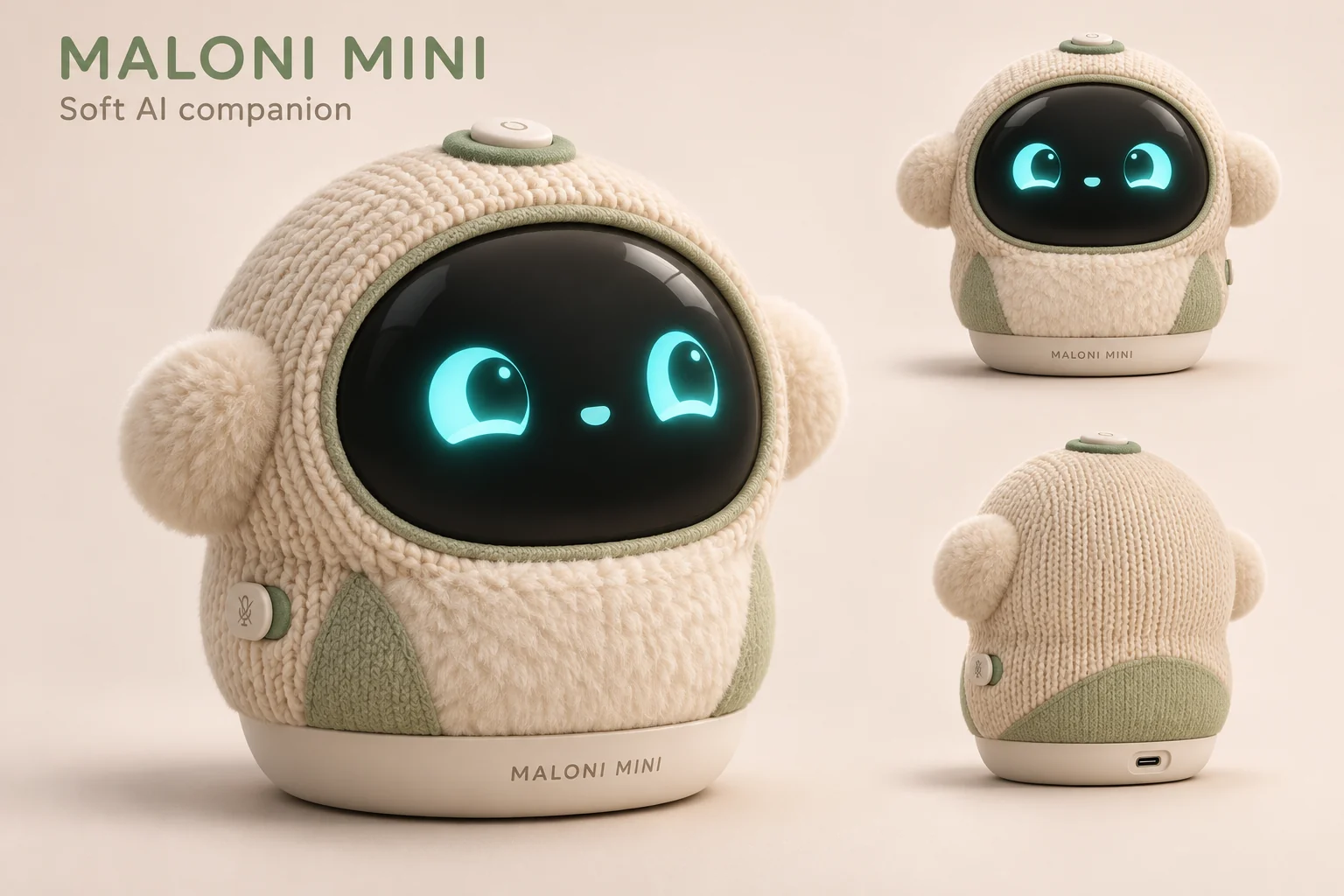
According to the supplied documentation, the body has an organic, slightly egg-shaped form. A separate oval black front module contains an actual rectangular 4.3″ 800 × 480 touch display. The camera sits above the display in its own opening. The rounded outline of the face does not mean a rounded display panel.
The design separates the rear service cover, Raspberry Pi carrier and base with a USB-C opening. It reserves locations for a speaker, microphones and textile ear attachments. A washable cover is an intention; its implementation still needs validation.
Which values are design choices and which are assumptions?
- Components named in the design: Raspberry Pi 4B 4 GB, Waveshare 4.3inch DSI LCD SKU 16239 and Raspberry Pi Camera Module 3. Actual connectors, cables and component fit must be measured and tested.
- Preliminary mechanical values: shell approximately 178 × 126 × 172 mm, assembled height approximately 197–200 mm without textiles, and nominal shell thickness 3–4 mm. These are not final product dimensions.
- Reserved space and assumptions: a 15 mm display envelope thickness, the ReSpeaker envelope, an approximately Ø40 mm speaker and a 70 × 30 × 24 mm battery space. The battery and final charging solution have not been selected. A USB-C opening is not evidence of working charging.
What do the CAD checks currently show?
According to the supplied documentation, checks of 14 STL part types found watertight surfaces and one connected object per part. No volumetric intersections were reported between simplified electronic envelopes and the basic plastic parts; a basic check of the main exterior parts also found no intersections.
These are figures reported by the project lead. The CAD files and reports themselves were not independently reviewed when preparing this article. Simplified envelopes do not cover detailed connectors, cabling or assembly movements and cannot replace physical fit checks.
What remains open?
Neither a physical prototype nor AI functionality has been verified. Plastic strength, service access, cooling under textiles, microphone and speaker acoustics, and safe electronics shutdown remain open.
The power design still needs a suitable battery pack, protection, power management, thermal safeguards and charging. Reserved CAD space establishes neither capacity nor battery life.
Children are among the intended future users, but suitability for children, material safety and certification have not been established. No age range is approved. Before any use by children, parental controls, AI behaviour and privacy for the camera, microphones and data also need to be addressed. The service model, data processing and any cloud features remain undecided.
Mini is not available to buy. Price, battery life and a launch date have not been set. Concept illustrations do not demonstrate actual materials, capabilities or completed production.
What comes next?
- Measure the actual display and camera, including connectors and flex cables, and revise CAD as needed.
- Trial-print the front module, LCD retaining frame and camera mount; check the opening, screw access and cable routing.
- Check Raspberry Pi and microphone module fit, the assembly sequence and service access.
- Test cooling and acoustics without a cover, then with temporary textiles.
- Separately design and validate power, AI software, privacy and conditions for any future use by children.
Results will be published with methods and limitations. MALONI Mini and the full development diary are led by Rostislav Sikora, who is the direct contact for prospective development partners.
Sources and provenance
- MALONI MINI – CAD V2.1 / mechanical prototype
Documentation supplied by Rostislav Sikora. Mechanical values and check results are reported information; CAD files have not been independently verified.
- Mini priority decision and concept illustrations
Rostislav Sikora / MALONI. Materials supplied for this website update, not photographs of a physical prototype.
- Waveshare 4.3inch DSI LCD
Component reference cited in the supplied documentation; it does not verify fit in Mini.
- Raspberry Pi mechanical documentation
Manufacturer mechanical documentation; actual fit and cabling require measurement.
- Raspberry Pi camera documentation
Manufacturer camera module documentation.