Project overview
| Platform | Virtual Unitree G1 model; this example does not specify the configuration of a robot offered for sale. |
|---|---|
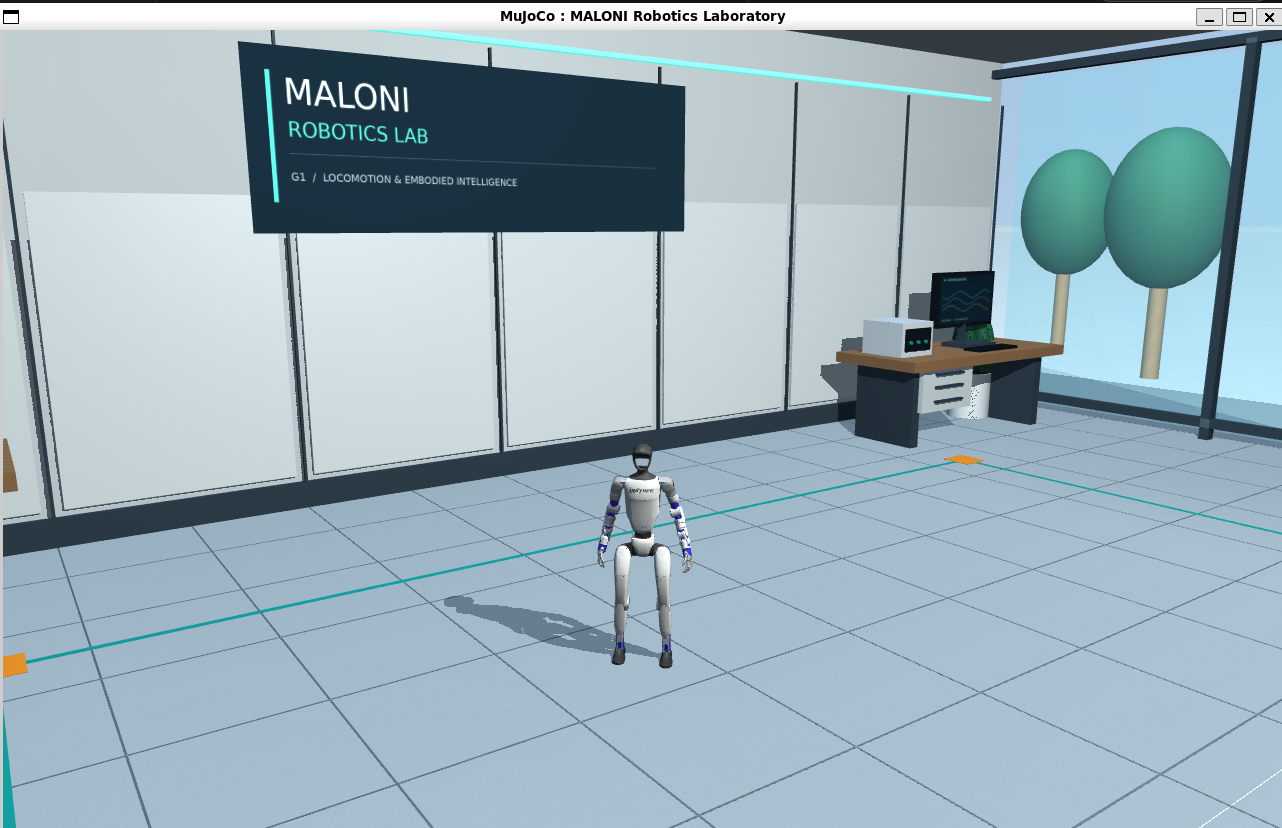
| Environment | MuJoCo; virtual MALONI Industrial Lab, labelled MALONI Robotics Lab in the evidence. |
| Validation status | Internal assisted simulation. Author confirmation, source code and screenshots; no newly reproduced tests. |
| Author | MALONI Robotics |
| Evidence revision | da5f9b1751adfe210ca74ef2a30e4d8aeac27bee |
| Publication | 21 October 2026 |
What we built and why
We connected a virtual scene, motion controls and a prepared task controller in one development demonstration. The aim was to understand how walking and manipulation connect and establish evidence for further development. Simulation helps explore a solution; it does not establish safety or readiness for real operation.
The task and MALONI’s contribution
Revision da5f9b1 documents a custom laboratory scene, keyboard controls, application task logic and integration changes. The task connects approaching a figurine on the floor, assisted transfer and placement on a designated table.
- MALONI: virtual lab layout, scene generation, sequence and route control, integration of walking and assisted manipulation, documentation and validation scripts.
- Upstream components: the Unitree G1 model, Unitree libraries, an existing walking policy exported to ONNX and the MuJoCo physics engine.
- We do not present the upstream policy as trained by MALONI. The documentation states that this demonstration runs without ROS or DDS; broader ROS 2 experience does not establish its use in this sequence.
The MALONI Industrial Lab environment
The virtual laboratory contains a floor, worktables, cabinets and storage elements, lighting and MALONI branding. The author also confirms shelving. Documentation describes collision objects and a defined test area; screenshots show particular views rather than every scene element. The MALONI Robotics Lab label in the images refers to this virtual laboratory.
Development according to the available evidence
This account follows the README, control documentation, pinned dependencies and task implementation. It is not a reconstructed development diary or a claim that the simulation was rerun while preparing this study.
- Integrating the model and scene in MuJoCo; custom changes and dependency revisions are recorded in dependencies/lock.json.
- Connecting the existing walking policy through ONNX and adding keyboard commands for local motion.
- Adding the task controller, route planning and arm control with assisted object holding.
- Preparing checks for completion conditions, reset and repeatable startup using a seed.
What was achieved and what the evidence supports
The author confirmed walking, autonomous movement and object grasping in simulation. The descriptions below bound these terms according to the available documentation. This study carries over no numerical benchmarks and infers no additional capabilities.
Walking in the prepared scene
Virtual model movement using an upstream ONNX policy and application commands.
- Author confirmation
- The author confirms working locomotion in the local simulation.
- Available record
- A motion article with a video and keyboard-control documentation exists. A still image alone does not establish walking.
- Test reproduction
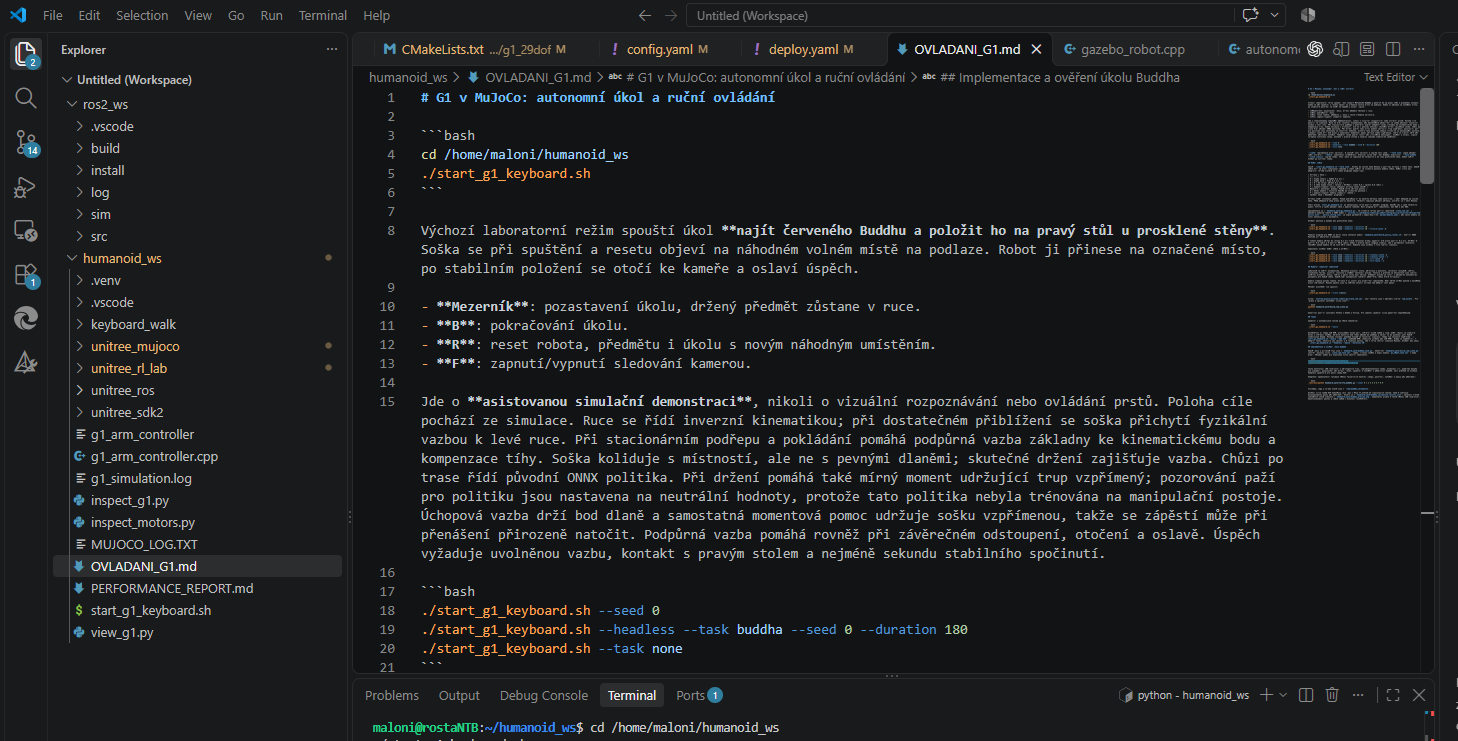
- OVLADANI_G1.md lists headless motion commands. They were not run for this study.
Autonomous execution of a programmed sequence
A controller runs a prepared task using target coordinates from the simulator. This is not camera recognition or general independent task planning.
- Author confirmation
- The author confirms autonomous movement in simulation.
- Available record
- The BuddhaTask controller and project video are available. On 21 October 2026 we verified playback and images of model movement in the virtual laboratory; the video is not an independent test of the entire implementation.
- Test reproduction
- Documentation describes seeded startup and a validation script. An available procedure is not evidence of a newly executed test.
Assisted object transfer and placement
The arms approach the object and an auxiliary physics constraint holds it; additional assistance stabilises the model and object. Independent finger grasping is not established.
- Author confirmation
- The author’s confirmation of grasping is interpreted within this documented assisted scope.
- Available record
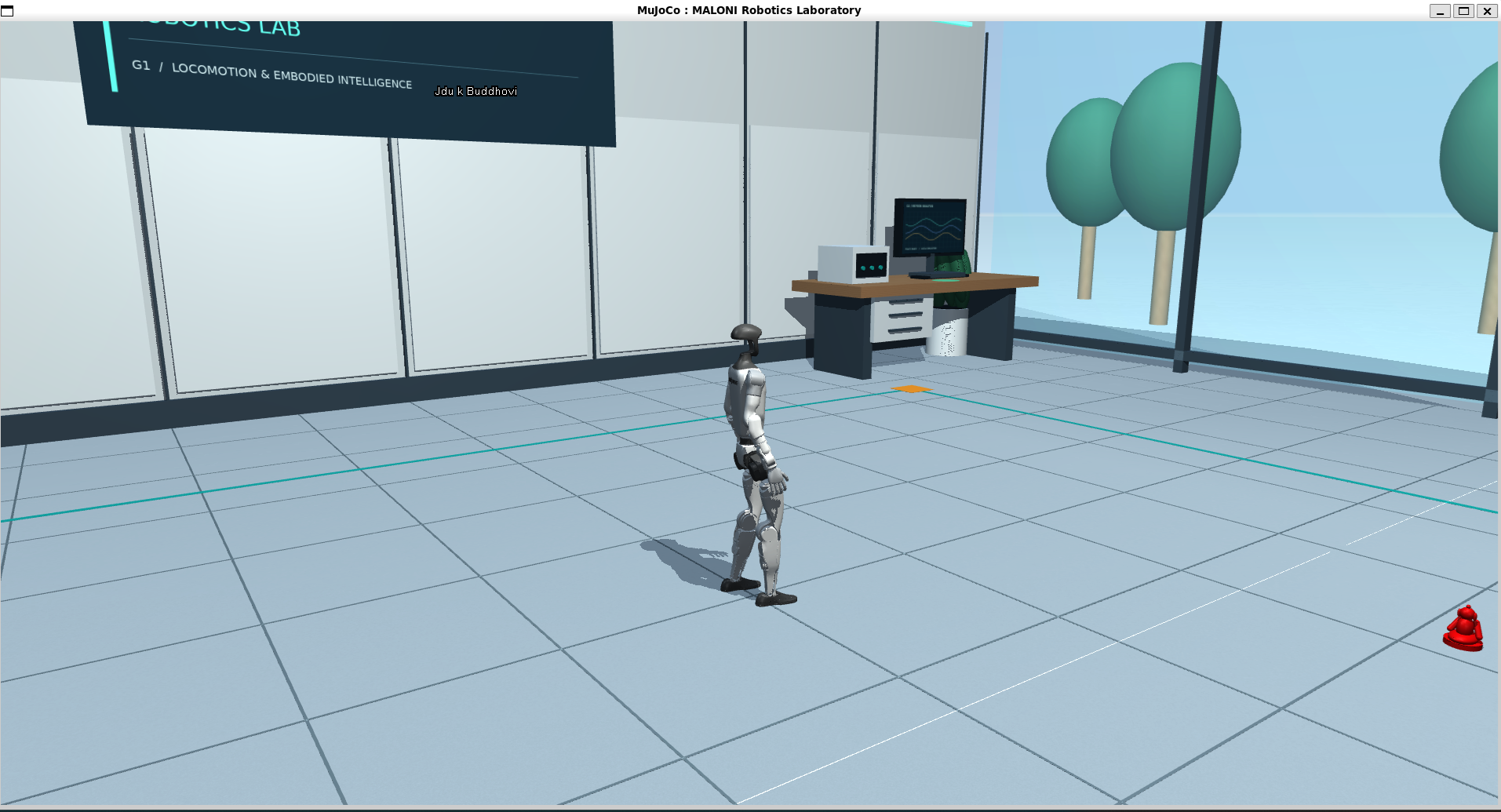
- Documentation explicitly describes constraints and stabilisation. The screenshot shows the scene before transfer, rather than evidence of grasping.
- Test reproduction
- verify_buddha.py checks task conditions. This study reports neither a new execution result nor physical robot performance.
Project video and screenshots
We use actual project material rather than generated illustrations. “MuJoCo MALONI Robotics Laboratory Ubuntu Autonomous Navigation” was published on 19 October 2026. On 21 October 2026 we verified playback, the title, date and thumbnail. The recording documents a simulation demonstration; it is neither a measured benchmark nor a physical robot trial.
Limitations and transfer to physical hardware
The simulator supplies state and coordinates that require sensors and state estimation in the real world. Physical actuators have different responses and limits; contact, friction and object holding may differ from the model. Communication and computation latency, lighting, obstacles and changing surroundings require separate validation.
Auxiliary constraints and stabilisation cannot be treated as capabilities available on a physical G1. Transfer would require a specific hardware configuration, perception and control validation, risk assessment and staged trials. This project establishes neither certification nor MALONI’s status as an independent testing authority.
Further development — planned, not completed
Directions discussed include spoken commands, conversation and independent planning of a “tidy the workbench” task. These functions are not results of this study. Further work may include camera perception, reducing simulation assistance and preparing physical validation; scope and feasibility remain to be confirmed.
How MALONI can help with your application
We start with the task and workplace. A humanoid may not be the right choice: we also consider a robot arm, mobile robot or other automation. This internal demonstration is not a completed customer solution or a promise of equivalent operational results.
- Assessing suitability for robotics and available technologies.
- Designing a pilot with an agreed scope and evaluation method.
- Development and simulation for a defined task.
- Preparing subsequent physical robot validation, subject to hardware availability and agreed conditions.
Sources and methodological notes
The basis is the project owner’s confirmation, existing MALONI media and public revision da5f9b1. We checked the control documentation and pinned dependency revisions on 21 October 2026. The README, controller and validation scripts are reproduction resources rather than independent confirmation of results. Technical context follows MuJoCo documentation and Unitree sources; manufacturer information is distinct from MALONI’s own results.
The checked project evidence does not specify a separate project licence. Upstream library and model licences must be considered separately; a public link does not imply unrestricted reuse. This study offers no new downloads of code, models or dependencies.