Project at a glance
| Project | Environment and status |
|---|---|
| Platform | Simulated Unitree G1 model with 29 actuators |
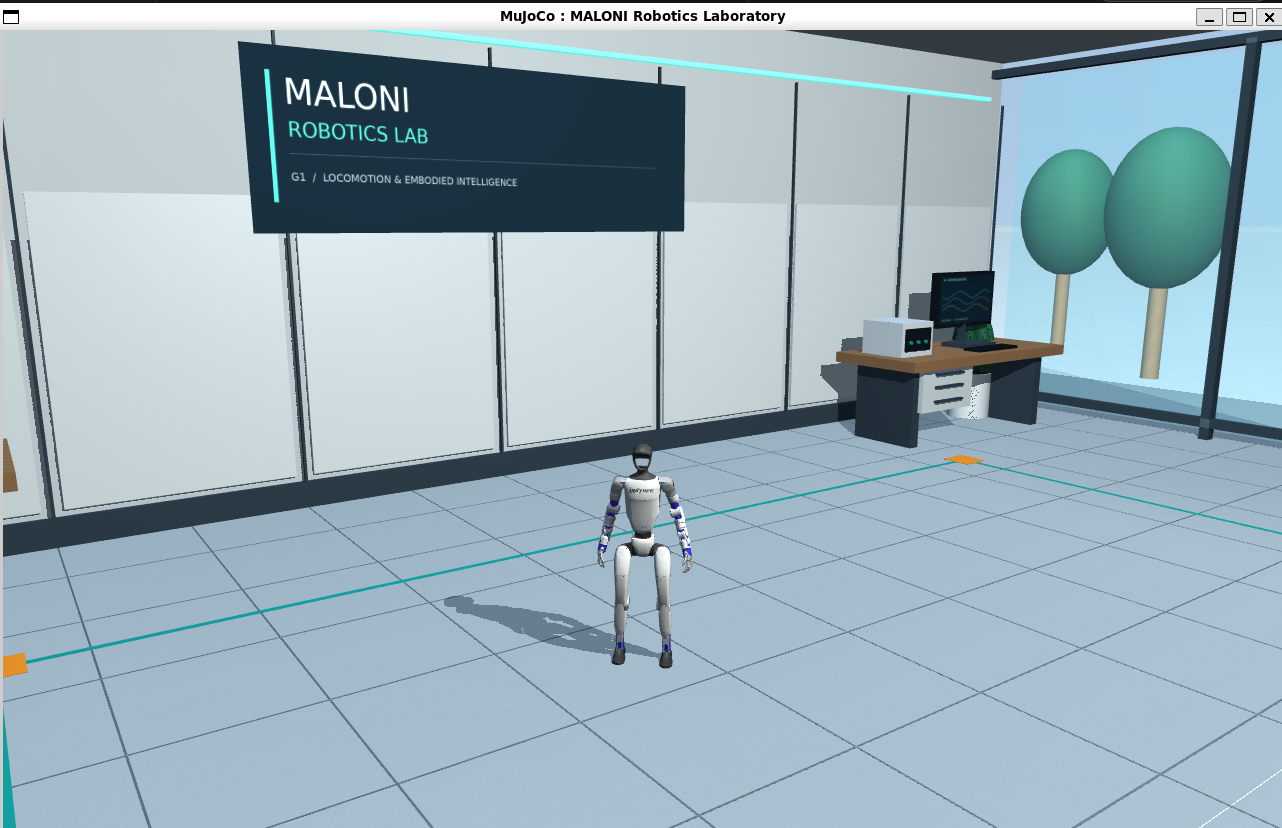
| Laboratory | MALONI Robotics Lab in MuJoCo |
| Software | C++, ROS 2 Jazzy, Unitree SDK2 and existing ONNX policies |
| Completed work | Simulation environment configuration and C++ control software build |
| Tool versions | ROS 2 Jazzy; exact MuJoCo, SDK2, ONNX runtime versions and model revision are not specified in this example |
| Next steps | Validating stable motion, navigation and manipulation |
| Physical robot | This project does not validate physical hardware performance or safety |
Our long-term objective is to establish MALONI Robotics as a regional partner for humanoid robot sales, integration, and technical support across Central Europe, with an initial focus on the Czech Republic, Slovakia, and Poland.
To achieve this, we believe it is essential to understand not only what humanoid robots can do, but also the software and control technologies behind their operation.
From ROS 2 and C++ to the Unitree G1 Humanoid Robot
Our development journey began with ROS 2 Jazzy and C++ programming.
We created and tested a series of applications for simulated robots covering motion control, autonomous waypoint navigation, sensor communication, LiDAR data processing, and obstacle detection.
These projects provided a foundation for working with more advanced robotic systems.
The next step was the Unitree G1 humanoid robot, a considerably more complex platform requiring coordinated control of multiple joints, actuators, and sensor systems.
For simulation, we selected MuJoCo (Multi-Joint dynamics with Contact), a physics engine widely used in robotics research and development.
Simulating Unitree G1 in MuJoCo
We integrated the official Unitree G1 robot model, featuring 29 actuators, into the MuJoCo simulation environment.
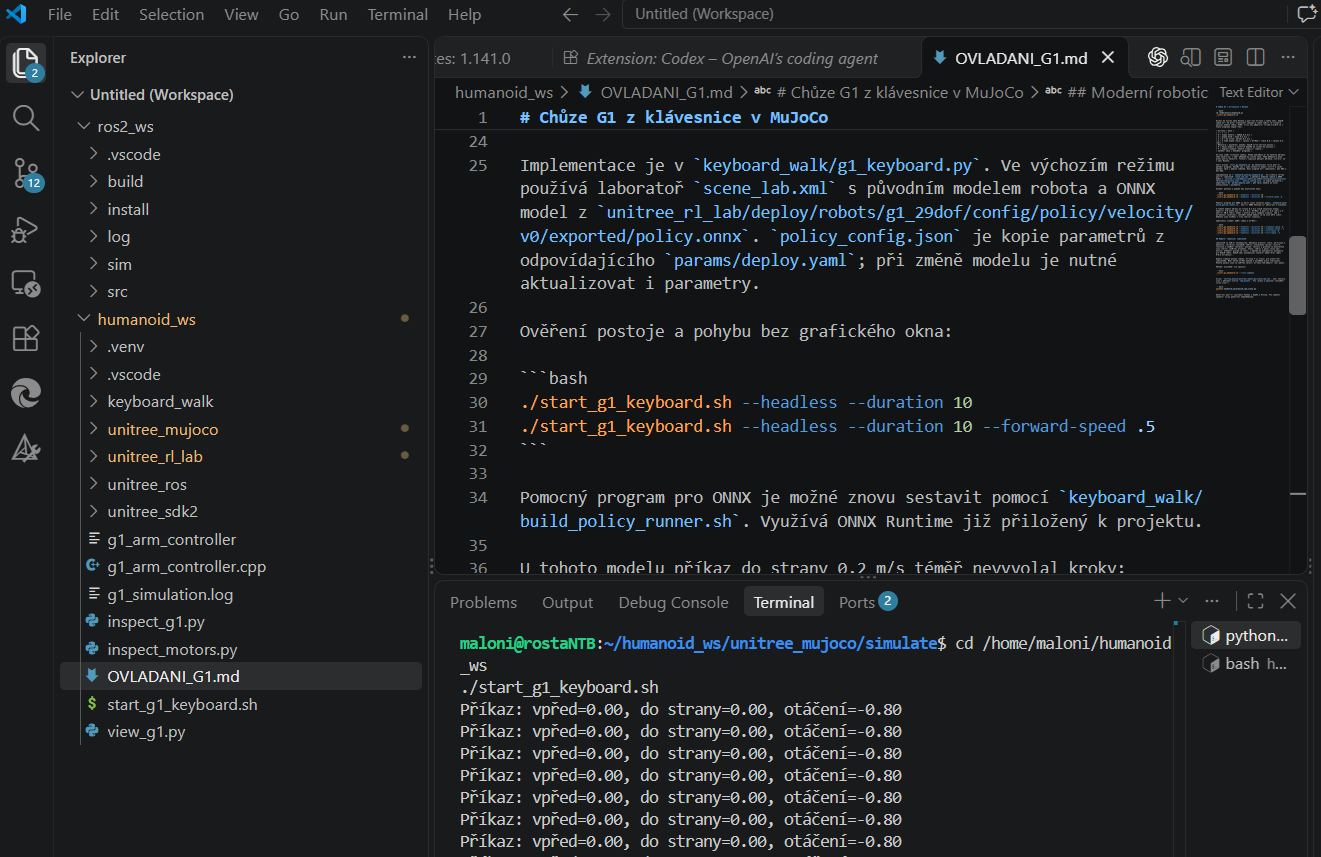
Our technical work included inspecting robot joints and actuators, configuring Unitree SDK2, building the C++ control application, and preparing existing ONNX-based motion control policies.
An important part of this process was configuring communication between the simulator and the controller.
This allowed us to work directly with the robot’s simulation architecture rather than relying solely on visual demonstrations.
MALONI Robotics Lab: Our Virtual Testing Environment
We also developed MALONI Robotics Lab, a dedicated 3D simulation environment designed for testing humanoid robotics applications.
Built using MuJoCo, the laboratory features the Unitree G1 robot model, a physics-enabled floor, a technical workstation, lighting, and MALONI Robotics branding.
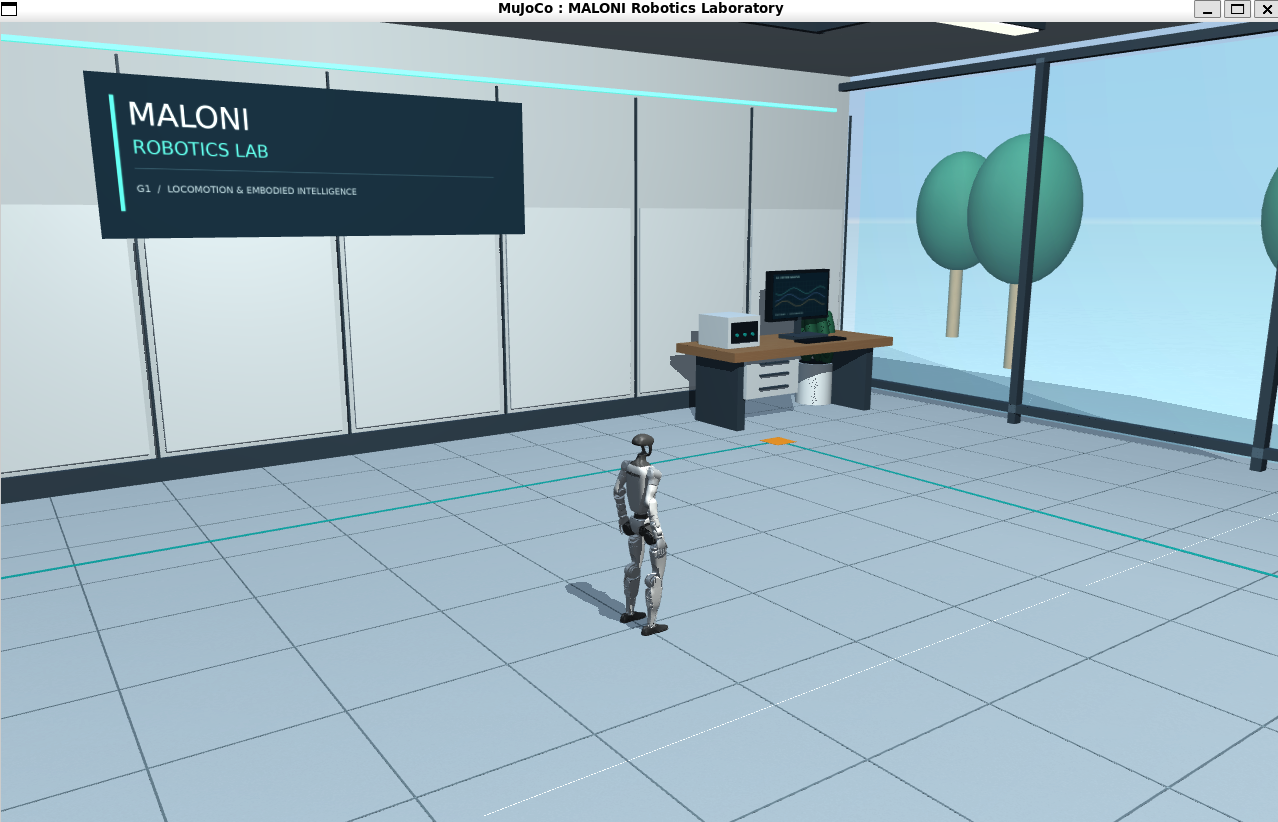
The environment provides a foundation for experimenting with robot motion, joint control, stability, and future manipulation tasks.
Virtual simulation allows us to evaluate and refine software in a controlled setting before considering experiments involving physical hardware.
Why Technical Expertise Matters
Deploying a humanoid robot involves considerably more than delivering the hardware.
Real-world applications require an understanding of robot control, operating conditions, safety requirements, sensing capabilities, and integration with existing systems.
At MALONI Robotics, we are developing technical expertise in:
- C++ programming and ROS 2 robotics development.
- Robot simulation using MuJoCo and Gazebo.
- Joint actuators, motion control, and feedback systems.
- Software integration using SDKs and communication protocols.
- Application development for industrial and service environments.
Our objective is to evaluate robotic technologies based on practical requirements rather than promotional demonstrations.
From Simulation to Real-World Applications
Our work demonstrates our ability to configure and operate a Unitree G1 simulation environment, build its C++ control software, and integrate existing motion-control components.
The next development stages will focus on validating stable motion, navigation, and task-oriented applications within MALONI Robotics Lab.
Simulation results do not automatically establish performance or safety on physical hardware. Real-world deployment requires further engineering, testing, and validation.
Our ambition is to build the technical capabilities needed to support the responsible integration and deployment of humanoid robotics across Central Europe.
MALONI Robotics – Humanoid Robotics, Simulation & Integration
More humanoid programming examples
Sources and further reading
- Unitree G1 Humanoid Robot Simulation | MALONI Robotics Lab | MuJoCo & C++ ↗MALONI Robotics / YouTube
- MuJoCo documentation: Overview ↗MuJoCo
The project description, screenshots and video come from MALONI Robotics development. MuJoCo documentation explains the simulation environment. These materials show simulation and do not establish physical robot performance or safety.