Interaction
Voice and camera inputs feed the dialogue and cue recognition modules. They request actions through a defined interface.
MALONI HUMANOID 120 / V1
V1 aims to welcome a visitor, hold a short conversation in Czech or English, react to a defined visual cue and travel within a marked test area.
Voice and camera inputs feed the dialogue and cue recognition modules. They request actions through a defined interface.
ROS 2 coordinates commands and telemetry. C++ control nodes command the wheeled base within approved speed and route limits.
Design a stop path independent of voice and vision, with an emergency stop and a safe response to loss of control. Drives, battery, sensors and stop limits still need engineering review.
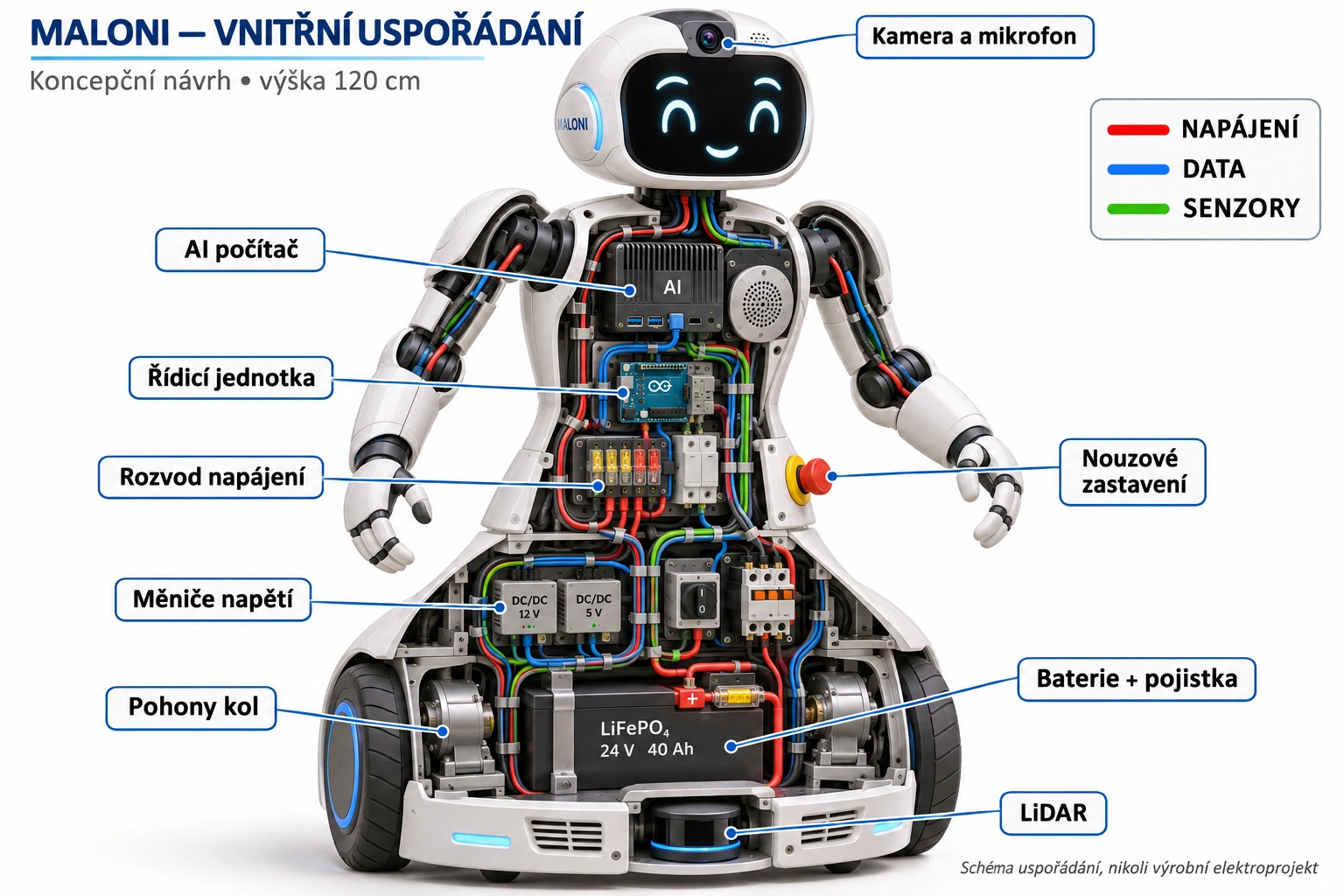
Concept illustration. The enclosure, component ratings and cable paths are illustrative. Final component selection and wiring require engineering validation.
Open the full-size diagram (Czech labels) →Run five scripted exchanges in each language. Log responses and mark each exchange against agreed expected behaviour.
Run cue-present and cue-absent trials. Log cue detection, missed cues and unintended triggers.
Repeat a marked route ten times on a test rig or prototype after confirming the stop system. Require zero boundary crossings.
Trigger the emergency stop and simulate loss of control. Measure stop time and distance against limits agreed before powered testing.
According to documentation supplied by Rostislav Sikora, Mini is at CAD V2.1, revision dated 12 November 2026. Physical assembly, AI functionality and suitability for children have not been verified. The technical V1 page below describes the historical Humanoid 120 concept.