| Case study at a glance | What the project documents |
|---|---|
| Project and creator | MALONI Humanoid · MALONI Robotics · Rostislav Sikora |
| Environment and model | Assisted MuJoCo simulation; now Aimoga Mornine as confirmed by the author, previously Unitree G1 |
| Connected capabilities | Object transfer, Czech conversation, fresh camera frames and controlled motion skills |
| Reported internal measurement | The fast profile completed the task in an average 79.42 s instead of 97.90 s of simulation time; an 18.88% time reduction according to the author |
| Platform focus | Development for Czechia, Slovakia and Poland; physical validation and assessment of a specific application remain next steps |
What is MALONI Humanoid and how does it build on Unitree G1?
The previous Unitree G1 case study introduced the virtual laboratory, walking and assisted object transfer. According to the author, the new stage with an Aimoga Mornine model connects manipulation with conversation and perception: the humanoid completes a task, prepares for conversation and, on request, obtains fresh visual context or performs a specific skill. The purpose is to explore the continuity of movement, perception and human interaction in one environment.
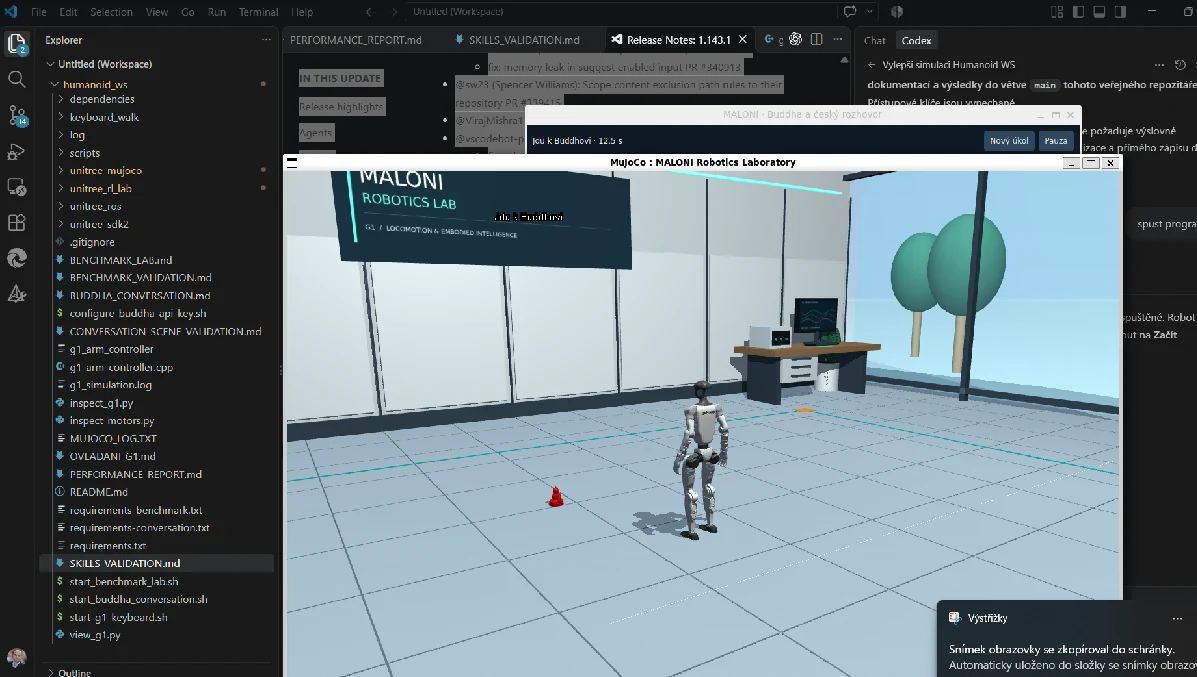
Video from the new development stage
Object transfer and faster task completion
The starting scenario is moving a Buddha figurine onto a table. The humanoid approaches the object, grasps it with assistance, carries it and places it down. After checking stable placement, it steps back, completes a six-second dance and prepares for conversation. Manipulation and stabilisation use simulation assistance mechanisms.
According to internal measurements, the fast profile reduced mean total task time from 97.90 to 79.42 seconds of simulation time. The saving is 18.48 seconds, or 18.88%. The reaching and grasping phase was reduced by 22.09%. This compares profiles of the given simulation task; it is not a measure of physical robot performance or cloud response time.
How does Czech conversation with the humanoid work?
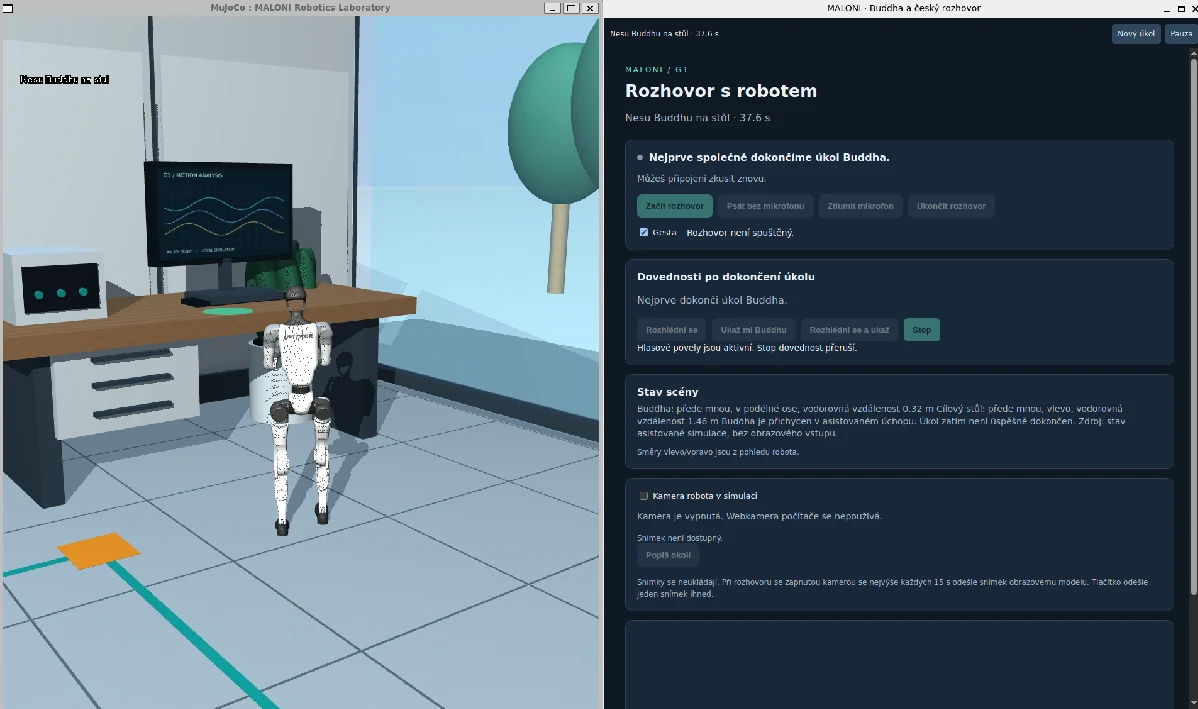
Once the task is complete, the user can start a Czech voice conversation. The panel provides live transcription, typed messages, microphone muting and disconnection. The humanoid accompanies its replies with gentle arm and torso movements.
Conversation uses data directly from the simulation state: the positions of the Buddha and table, whether the object is attached, its stable placement and task duration. These data allow it to describe the actual sequence. They are distinct from visual recognition through a camera: knowing simulation coordinates does not itself prove that the robot recognised the object in an image.
How does the humanoid use its camera and look around?
The camera is mounted on the robot in the MuJoCo simulation. Questions such as “Co vidíš?” (“What do you see?”) or “Kde se nacházíš?” (“Where are you?”) request a new frame and update the visual context before the reply. The response can therefore use a fresh view of the scene.
- “Rozhlédni se” (“Look around”) triggers a smooth turn with views from four directions, followed by a return to the original orientation. The summary distinguishes observations obtained in sequence; they are not a single simultaneous panoramic image.
- “Ukaž mi Buddhu” (“Show me the Buddha”) turns the humanoid towards the object, checks its visibility in the render and triggers a pointing action with the right arm.
- Looking around and pointing can be combined into a sequence. The “Stop” command interrupts the activity in progress.
How are voice commands separated from motion control?
The language model does not set joint positions. Supported Czech phrases select a specific skill, which a local controller executes with limits on speed, joint ranges and obstacle clearance. Network communication and image processing run outside the physics loop, so the simulation continues even when a cloud response is slower.
This separation allows conversation, perception and skill execution to evolve independently. The described limits and interruption with “Stop” are properties of the internal simulation solution; they do not constitute a verified safety system or an emergency stop for a physical robot.
Internal test results in MuJoCo simulation
The following values are taken from Rostislav Sikora’s statement and describe internal testing in an assisted simulation. Times are simulation times; original test reports and a new code revision are not among this study’s public supporting materials.
| Measurement or check | Reported internal result |
|---|---|
| Mean total task time | Original profile 97.90 s → fast profile 79.42 s of simulation time |
| Reduction in total task time | 18.88% |
| Reduction in reaching and grasping time | 22.09% |
| Completed validation runs | 10 of 10 for the original profile; 10 of 10 for the fast profile |
| New skills | 30 physics scenarios across ten seeds, with no fall or dropped object |
| Largest foot displacement during final standing | 3.62 mm |
| Unit tests | 63 passing tests |
Developing a platform for Czechia, Slovakia and Poland
This vision points towards MALONI’s own humanoid development platform focused on Czechia, Slovakia and Poland, with regard to applicable EU requirements. Czech conversation is a concrete current part of that direction; it does not substantiate additional languages or operational readiness across the region. The statement expresses a development goal, not certification or demonstrated regulatory compliance.
Here, our own platform means developing scenes, application logic and connections between capabilities. The previous stage used a Unitree G1 model and an existing motion policy; according to the author, the new demonstration uses an Aimoga Mornine model. Public revision da5f9b1 still relates to the previous stage. This does not mean proprietary humanoid hardware or independence from all external components.
Common questions about MALONI Humanoid
Is MALONI Humanoid a physical robot?
This case study describes an internal software project in assisted MuJoCo simulation. According to the author, the new footage uses an Aimoga Mornine model. Simulation results alone do not substantiate a real robot’s capabilities or a customer deployment.
What does the 18.88% reduction in task time mean?
According to internal measurements reported by Rostislav Sikora, the mean duration of the same simulated task fell from 97.90 to 79.42 seconds. Each profile completed ten out of ten validation runs. The figure expresses a relative saving in simulation time, not a demonstrated productivity improvement for a physical robot.
Does the study demonstrate certification or EU compliance?
No. The study documents the direction of internal development as reported by the author, not certification or demonstrated regulatory compliance. Physical robot safety and the requirements for a specific future application will need separate assessment and verification.
What needs to be verified next
The current result provides a practical foundation for further development: completing a manipulation task, moving into conversation, obtaining a fresh view of the surroundings and performing a supported skill. Transfer to a real robot will require separate development, assessment of the specific application and physical verification. This study does not describe a customer installation.
The supplied video and images show the environment of the new development stage. Numerical results and features not directly demonstrated in the footage remain attributed to internal testing. Have a specific development project in mind? Describe the task, environment and expected outcome using the contact link below.
More humanoid programming examples
Sources and further reading
- Maloni humanoid using Aimoga MOrnine humanoid ↗MALONI · YouTube · 23 October 2026
- README — previous stage, revision da5f9b1 ↗MALONI · GitHub
- Controls and assisted simulation — previous stage ↗MALONI · GitHub
The new features and numerical results are based on internal testing as reported by Rostislav Sikora on 23 October 2026. They were not independently reproduced while preparing this study. Links to public revision da5f9b1 document the previous stage; that revision does not yet substantiate the new voice features or the reported measurements.