
“We finally have our own simulation solution for humanoid learning. It is a major milestone for the MALONI team,” says Rostislav Sikora. Learning here describes the intended use of the environment for further development. The current result is a working simulation using an existing walking policy, rather than an announcement of a newly trained policy or transfer to a physical robot.
This stage builds on MALONI’s virtual showroom, whose previous account described a MuJoCo foundation. The earlier contribution focused on environment design, scenarios and integration. According to the new development summary, MALONI now also controls the physics computation and its connection to humanoid behavior. The visitor scenario has therefore gained a new technical foundation.
Walking comes from physics and a trained policy
The Unitree G1 model moves through physics simulation and an existing ONNX motion policy. The internal account describes walking rather than a prepared walking animation. Control uses the simulation state and acts on the joints through motor torques. The resulting motion comes from the interaction of the policy and the simulated robot in its environment, rather than simply replaying the same sequence of poses.
The contributions need to be distinguished. An in-house MALONI engine does not mean an in-house humanoid model or a newly trained walking policy. The G1 model and already trained ONNX policy remain existing foundations. The newly described work concerns simulation computation and the control connection. This interface provides a place to examine how motion and the application scenario affect each other.
An escort ends when the destination is reached
A practical result is the transition from an escort to a presentation. The robot can accompany a visitor to a displayed car, stop, turn toward it and begin presenting it. Arrival confirmation comes from the position actually reached in simulation. This distinction matters to the visit scenario: accepting a movement request and completing the movement are different events.
Dialogue, customer questions and preparation of a salesperson summary follow the motion. These are connected steps within a virtual visit. Producing a summary does not establish delivery to a real salesperson or a CRM integration. Presenting a displayed model likewise does not confirm the current price, equipment or availability of a car at a real dealership.
What the in-house engine includes
The internal summary describes in-house robot dynamics, motion integration, contact impulse resolution and a Python control interface. In simple terms, these components determine how motion develops over time and how contacts affect it. MALONI continues to use existing libraries for mathematics, collision detection and rendering. An in-house solution therefore does not mean that the team wrote every component from scratch.
Running without the MuJoCo runtime describes the dependencies of the current showroom execution. It does not erase the earlier development stage or confer authorship of retained models. The team gains control over its simulation computation and connection to control. The supplied material contains no comparative accuracy or performance measurements against MuJoCo, so this milestone does not establish equivalence or superiority in those areas.
What MALONI reports from internal verification
According to the new summary, escorts passed for all three displayed cars: the BMW X1, Volvo XC60 and CHERY Tiggo 8 Pro. The checks also covered returning to reception and an interactive visit from the simulated customer’s arrival through the presentation to departure. These results relate to the described virtual environment, rather than a physical robot moving among customers.
MALONI reports 48 successful tests and an inspection of the actual web interface in Chromium. Beyond motion, the checks reportedly covered dialogue, cameras, stopping, reset and the response to a disconnected control panel. The number is attributed to the supplied internal account. The tests were not independently repeated during preparation of this article, and their precise execution date was not supplied.
A foundation for learning work still ahead
The working environment lets the team repeat scenarios, observe humanoid behavior and evaluate changes. Further work is intended to include adaptation, experimentation and eventual policy retraining on the in-house simulator. That is a separate step from the current use of an already trained policy. This article does not announce completed new training or a measured improvement in humanoid capabilities resulting from it.
Transfer to a real robot will also require separate verification. A successful simulated visit does not establish operational safety, reliability at a real dealership or readiness for deployment. The new milestone expands MALONI’s own development tool. The direction toward AiMOGA platforms and other services remains a subsequent ambition, rather than a result evidenced by these tests.
If you operate a dealership or another service and would like to discuss a specific assistant scenario, describe the space, visit and task the robot should handle. Include the situations in which staff should take over. This helps define further development and verification; it is not a promise that a finished operational solution is available.
Related reading and project preparation
More humanoid programming examples
- MALONI develops a virtual showroom for humanoid assistants. Hotels and shops are planned next
- Aimoga Mornine in a CHERY showroom: a MuJoCo simulation
- MALONI Humanoid: Czech conversation and robot vision in MuJoCo
- Programming the Unitree G1 humanoid in MuJoCo simulation
- Unitree G1: Autonomous Object Transfer in Assisted MuJoCo Simulation
- Unitree G1 in MuJoCo: Motion Control and MALONI Software Development
- Unitree G1 at MALONI Robotics: Building Our Own Humanoid Robot Simulation Laboratory
Sources and further reading
- MALONI virtual showroom: the previous MuJoCo stage ↗MALONI Robotics · 5 November 2026
- MALONI: from humanoid platforms to working robots ↗MALONI Robotics · vision and development
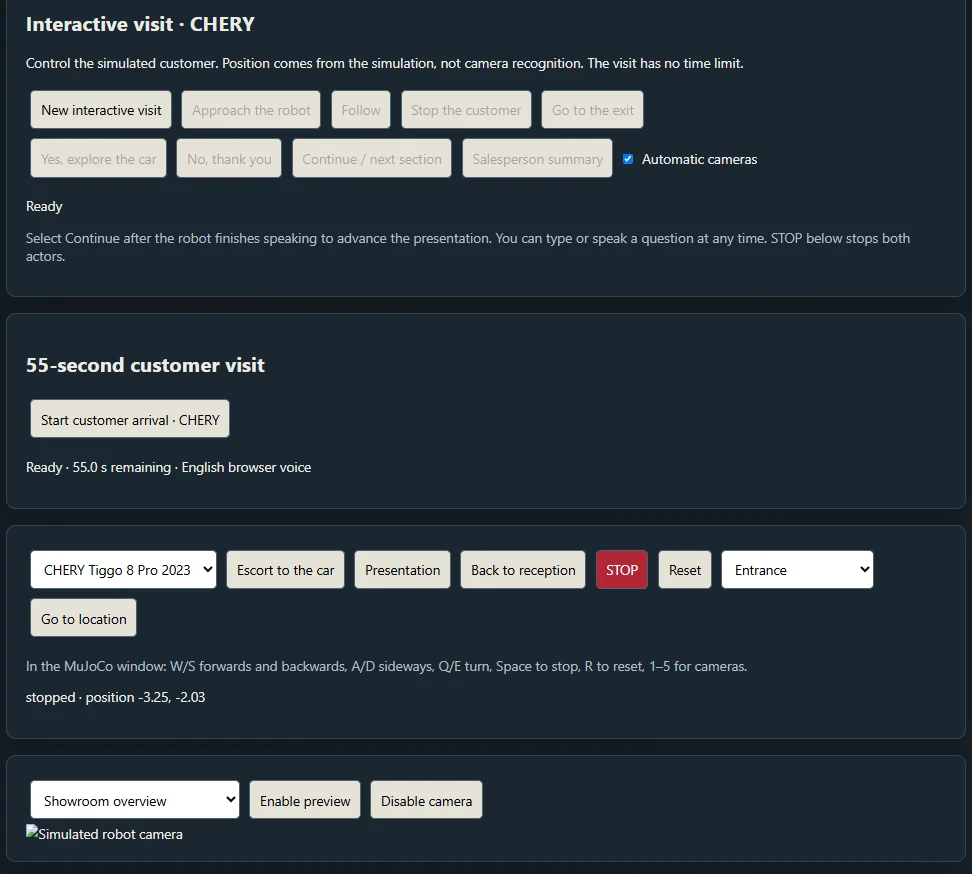
The account of the new engine, its functions and 48 tests comes from an internal summary supplied by Rostislav Sikora for this article on 6 November 2026. The source code and complete test records were not audited during editorial preparation, and the robotics tests were not rerun. The supplied account did not specify when those tests were performed. The panel screenshot comes from the previous simulation stage; it does not establish operation of the new engine.