In this study, the humanoid AiMOGA Mornine is a model in MALONI’s development simulation. The product profile describes the platform itself; the visit and results below come from this project’s internal material.
| Case study at a glance | Scope of this stage |
|---|---|
| Project and creator | MALONI Robotics virtual showroom · Rostislav Sikora |
| Humanoid and environment | Aimoga Mornine as confirmed by the author · MuJoCo simulation |
| Scenario | Greeting, consent to an escort, walking to the car, Czech presentation and a salesperson summary |
| Two modes | A 55-second demonstration and an interactive visit without a fixed time limit |
| Reported internal checks | Three repeated visits; approximately 25.2 s to the presentation point and a minimum customer distance of 1.49 m |
The existing MALONI–AiMOGA collaboration and preparation of presentations are described in MALONI’s AiMOGA profile. We distinguish this collaboration from verification of a particular simulation demonstration or its deployment in a dealership.
From the simulation laboratory to a virtual car showroom
The previous study of MALONI’s Czech conversation and robot vision connected communication, camera perception and controlled skills. We are now placing these capabilities into a continuous showroom visit: the robot greets a visitor, offers to accompany them to a car and starts its presentation after arriving. The aim is to develop the continuity of communication, navigation and customer interaction in one environment.
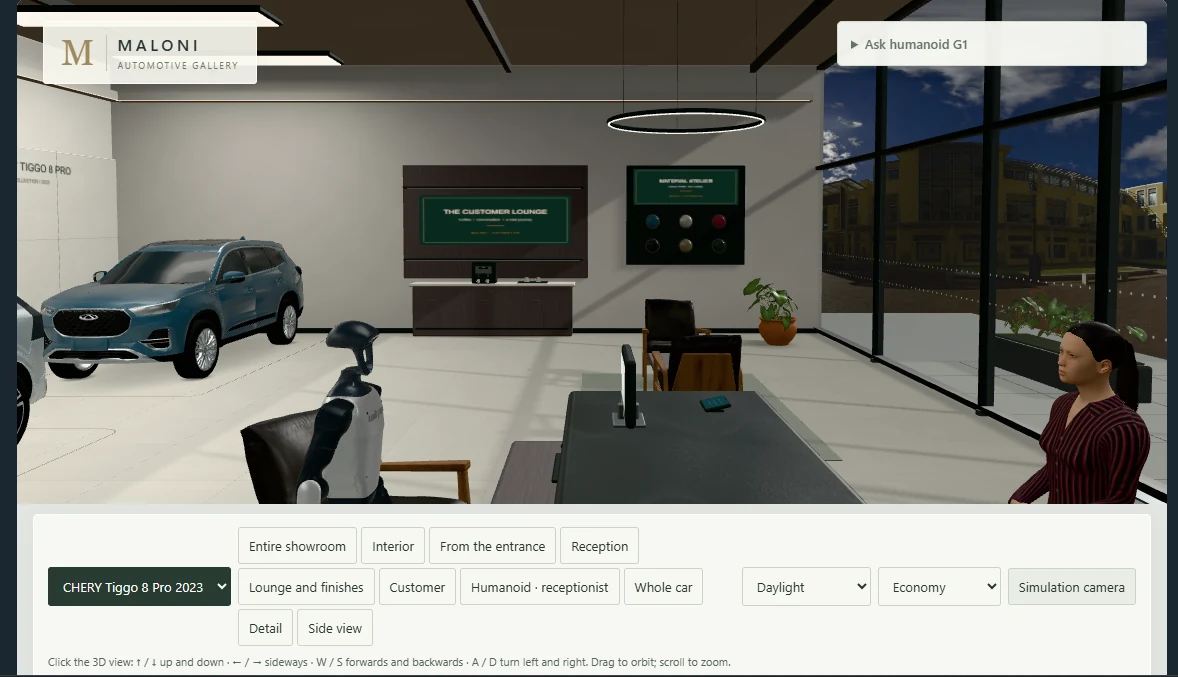
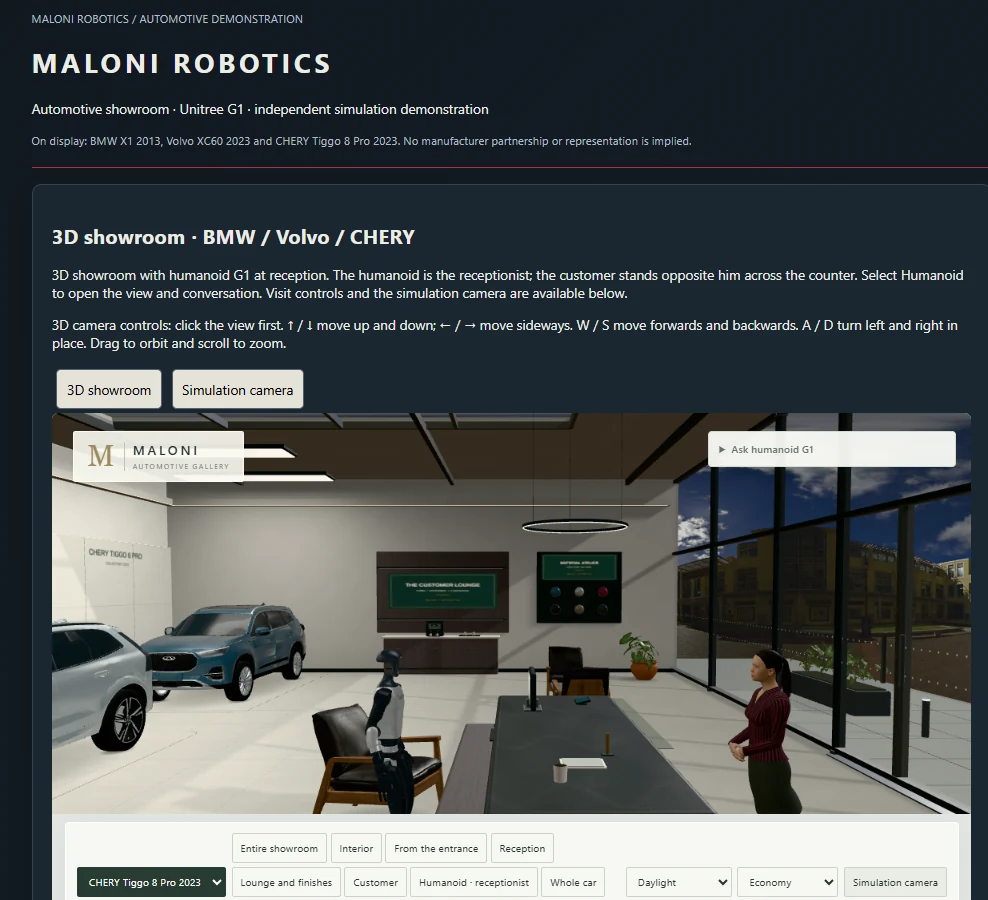
The showroom now includes glazing, MALONI Robotics reception, customer seating, information stands and three display areas. The dashboard offers BMW X1 2013, Volvo XC60 2023 and CHERY Tiggo 8 Pro 2023 models; the interactive scenario focuses on CHERY. These names identify display objects and do not confirm a manufacturer’s current vehicle range.
According to the development material, the team added more detailed car models with recorded sources and licences, adjusted materials and lighting, and prepared presentation cameras. Visual geometry is separated from simple collision envelopes: decorations do not affect contact dynamics, and the robot moves over a continuous flat floor. We did not independently audit the licence records while preparing this article.
Video: a showroom visit with a humanoid guide
How does the humanoid guide a virtual customer?
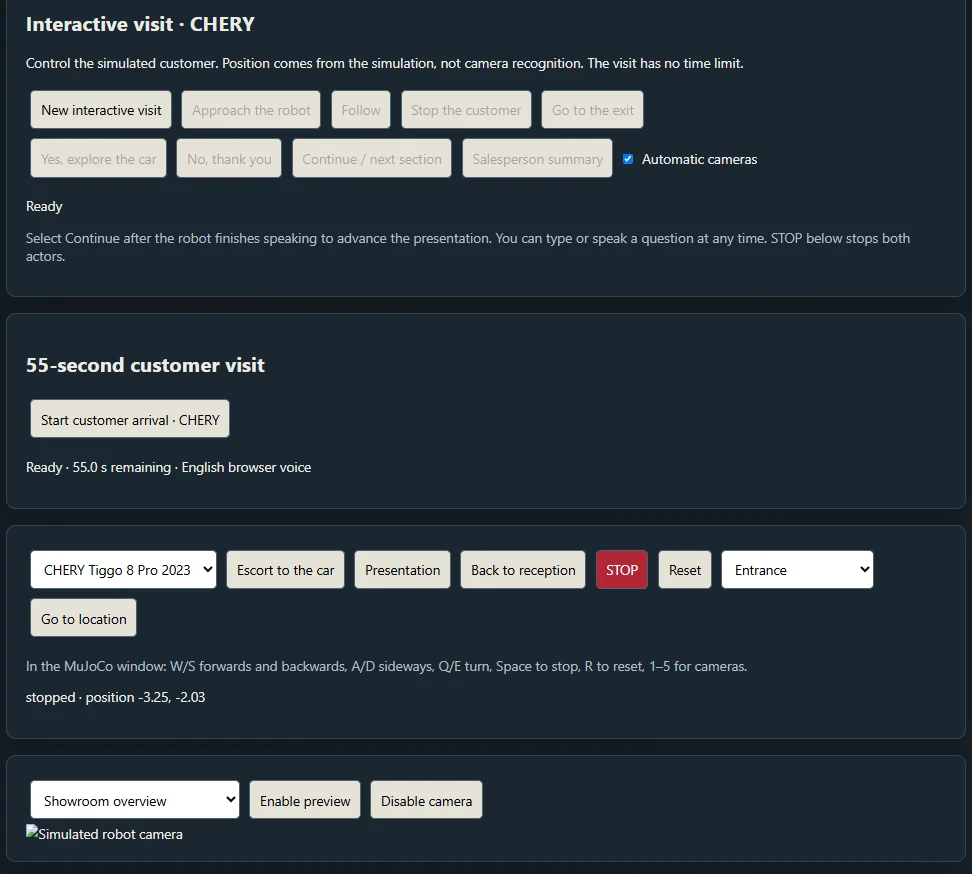
An operator can start a standalone 55-second demonstration or an interactive visit with no fixed time limit. In the latter mode, the operator controls the customer: approaching, following the robot, stopping or leaving. The controller obtains the actor’s position directly from the simulation. This differs from robot vision, which processes sensor images; this visit does not demonstrate camera recognition of a real person.
- Greeting and an invitation: the robot responds to both acceptance and refusal of the proposed escort.
- Walking to the car: if the customer falls behind, the robot waits; if they come too close, it stops and waits for confirmation to continue.
- Presentation: it starts only after the robot actually reaches the presentation point and stops in the simulation.
- Information handover: the conversation produces a summary for a salesperson, not a real booking or order.
What does the operator dashboard control?
The dashboard offers vehicle selection, navigation targets and cameras, including entrance, reception, customer, humanoid and car-detail views. Alongside visit controls, it provides escorting, presentation, return to reception, reset and a shared Stop for both actors. An operator can show the same scenario as a short presentation or explore individual interactions.
Czech conversation that can be interrupted by a question
Voice and text inputs use the same local controller. The CHERY Tiggo 8 Pro presentation can be interrupted with a question and then resumed. Conversation, movement and the demonstration scenario have separate states; the voice service does not directly decide robot motion.
The robot distinguishes a description of the displayed object from unverified product information. It does not invent current pricing or equipment. Instead of making a real reservation, it prepares a summary for a salesperson. This keeps the presentation within the available information and leaves a specific commercial offer to a person.
Technical background: MuJoCo, navigation and local control
MuJoCo is a physics simulator for models interacting with their environment; its principles are explained in the official MuJoCo documentation. The supplied project material specifies MuJoCo 3.15.0 and Python 3.12. The motion foundation builds on an existing ONNX policy and velocity controller from the previous Unitree G1 simulation stage. The author confirmed an Aimoga Mornine model for the new demonstration; the public code does not yet substantiate its specific implementation. According to the internal account, escorting uses simulated walking rather than sliding the model through the scene, and the main demonstration runs without starting ROS or DDS. The simulator documentation explains the technology, not MALONI’s results.
MJCF scenes, external models, textures and shared materials define the environment. Navigation uses A* on a grid with 25 cm resolution; static obstacles are expanded by a 75 cm margin. In interactive mode, the controller checks the simulated customer’s position before each motion command. These parameters belong to this particular internal scenario and do not establish validated safety distances for a physical robot.
The web dashboard communicates with a local Python server through /action and /state. Commands enter a queue and are executed by the main simulation loop. A visit identifier, run_id, separates runs so that a delayed command after reset cannot trigger movement in a new visit. Separate states allow speech interruption, stopping and resetting without mixing old and new visits.
What did internal testing show?
The following results are taken from the development material supplied by Rostislav Sikora. They concern three repeated interactive visits in simulation, not field trials with people. We did not independently repeat the measurements; public test reports for this new stage are not yet available.
Methodology and scope of available evidence
- Source: internal development material supplied by Rostislav Sikora for this article on 27 October 2026. The exact test date was not specified.
- Scenario: three repeated interactive visits with a controlled virtual customer; observing arrival at the presentation point, distance, stability and contacts.
- Arrival is reported at approximately 25.2 s, with a minimum distance of 1.49 m. No protocol specifying the time base, measurement start or geometric definition of distance has been published.
- Individual run values, seeds, detailed conditions and a new public revision have not been published. Variability cannot be calculated from these figures, nor do they establish a general safety guarantee.
| Check | Reported internal result |
|---|---|
| Repeated interactive visits | 3 visits |
| Reaching the presentation point | Approximately 25.2 seconds in the reported visits |
| Minimum customer distance | 1.49 metres |
| Stability and contacts | No fall or contact with furnishings in the reported runs |
| Further checks | Walking, distances, interruption, reset and preservation of existing functions; regression and new interaction tests passed according to the author |
Next step: assessing a real application beyond the demonstration
The result is a more usable environment for MALONI Robotics demonstrations: a visit has a beginning, a customer decision, a walk to the car, a presentation and an information handover. Further development can test continuity between these steps and behaviour during interruptions. Transfer from simulation to a physical robot (sim-to-real) will require separate integration, verification of real-visitor perception and assessment of the specific operation and applicable EU requirements.
The demonstration does not establish certification, demonstrated regulatory compliance or readiness for autonomous customer service in a dealership.
For similar scenarios, we offer robot programming for a specific task. Discuss showroom development with MALONI: describe the setting, visitor journey and expected role of the robot. Development scope and physical validation are agreed for each project.
Common questions: a humanoid guide in a car showroom
How does Aimoga Mornine serve a customer in this demonstration?
In MALONI’s simulation, the humanoid greets a controlled virtual customer, offers to accompany them to a CHERY Tiggo 8 Pro and presents the car in Czech after reaching the destination. According to the internal account, it responds to acceptance and refusal and waits if the customer falls behind. This does not establish service of a real customer by a physical robot.
Does the robot detect customer arrival with a camera?
No. In this showroom scenario, the customer is a virtual actor controlled by an operator. The controller obtains their position directly from the MuJoCo simulation state. Camera recognition of a real visitor remains a separate development and verification task.
What does the operator control in the showroom dashboard?
The operator selects the vehicle, cameras and navigation targets and controls the virtual customer’s arrival, following, stopping or departure. The dashboard distinguishes a 55-second demonstration from an interactive visit without a fixed time limit. It also offers presentation, return to reception, Stop and reset.
What do the 25.2-second and 1.49-metre results mean?
In internal material, Rostislav Sikora reports approximately 25.2 seconds to reach the presentation point and a minimum customer distance of 1.49 metres across three repeated visits. A detailed protocol and measurement definitions have not been published. The figures are neither a safety guarantee nor a productivity measurement for a physical robot.
Is the solution ready for a real car dealership?
This study describes MALONI’s development simulation, not a substantiated customer deployment. Physical operation requires separate integration, sensor and motion verification, and assessment of the environment and applicable EU requirements. The MALONI–AiMOGA collaboration alone does not establish approval of this particular demonstration by CHERY.
More humanoid programming examples
- MALONI has an in-house humanoid simulation engine. Its virtual showroom runs without MuJoCo
- MALONI develops a virtual showroom for humanoid assistants. Hotels and shops are planned next
- MALONI Humanoid: Czech conversation and robot vision in MuJoCo
- Programming the Unitree G1 humanoid in MuJoCo simulation
- Unitree G1: Autonomous Object Transfer in Assisted MuJoCo Simulation
- Unitree G1 in MuJoCo: Motion Control and MALONI Software Development
- Unitree G1 at MALONI Robotics: Building Our Own Humanoid Robot Simulation Laboratory
Sources and further reading
- A Humanoid Car Sales Assistant? CHERY Showroom Simulation | MALONI Robotics ↗MALONI · YouTube · 27 October 2026
- MuJoCo — official physics simulator and MJCF overview ↗MuJoCo · technology documentation, not MALONI’s results
- Project GitHub — previous stage, revision da5f9b1 ↗MALONI · GitHub · 19 October 2026
The new features, technical parameters and results are taken from internal development material supplied by Rostislav Sikora for this article on 27 October 2026. They were not independently reproduced during preparation. Public GitHub revision da5f9b1, dated 19 October 2026, documents the previous G1 stage; it does not yet substantiate this showroom or the new measurements. Supplied screenshots and the video description still refer to G1; the author explicitly confirmed Aimoga Mornine for the new demonstration.